Before dawn on March 1, 2026, Iranian Shahed drones struck two Amazon Web Services data centers in the United Arab Emirates. A third commercial data center in Bahrain was hit, although it is unclear whether it was targeted. Iran has also indicated that it considers commercial data centers targets.
This is the first time a country has targeted commercial data centers during a war. Data centers have been the target of espionage and cyberattacks in the past, most notably when Ukrainian hackers destroyed information stored in a Russian military-related data center in 2024. However, this was a physical attack. Drones have destroyed buildings.
Advances in artificial intelligence have increased the importance of data centers. The US military, in particular, has made extensive use of AI systems for decision support in their attacks on Iran and Venezuela. Depending on how important the data centers are, Iranian forces may target facilities that Iranian leaders believe support Iranian strikes.
It is not at all clear that these data centers were used by the US military. Instead, the attacks may be part of a broader effort to punish the United Arab Emirates for its relations with the US.
In my experience as a Ph.D. candidate at Georgia Tech who studies how technology is driving changes in international security, I don’t think the attacks represent a significant change in the nature of war. But they are forcing countries to recognize that data centers are targets of war – even if they do not directly support military operations.
Data centers and the cloud
The United States military is incorporating advanced AI capabilities into decision support systems. From the operation to capture Venezuelan President Nicolás Maduro to support military attacks against Iran, the US has been using AI, particularly Anthropic’s Claude, for intelligence analysis and operational support.
AI is unlocking faster ways of doing things in war, but the AI tools that the military often uses are not available on a plane or a ship. When a member of the service uses Claude, the computing resources that power the model and its analysis often go to the secure Amazon Web Services cloud that hosts confidential government data and software.
Enterprise data centers are where the cloud lives. The next time you pull up Netflix and watch your favorite shows, you’re probably running the show from a data center, perhaps AWS. When AWS data centers go down, the outage affects all kinds of entertainment, news and government jobs.
With AI as a driver of economic growth, data centers are an important type of infrastructure. They ensure that AI can continue to work, along with many of the networks that governments and industry rely on. When Iran attacked data centers in the UAE, it caused widespread disruption to the local banking system.
Enterprise data centers enable much of the technology that powers the modern world, including AI systems. Disrupting them is key to disrupting the nation’s military and public. Because AWS provides and operates many commercial data centers where the cloud resides, it is likely that its data centers will continue to be subject to conflict.
According to US alliances
Researchers at Just Security noted on March 12, 2026, that the United States requires Internet service providers to store government and military data inside US or Defense Department facilities: “Transferring such data to Amazon’s data centers in the Gulf region would require special authorization; we do not know if that has been granted.”
However, Iran’s Islamic Revolutionary Guard Corps said the strikes were against data centers supporting “enemy” military and intelligence activities. And 10 days after the first attack on the data centers, the Iranian news agency said that the main centers of technology companies and other assets in the region were considered as “enemy’s technological facilities.”
Instead of military reasons, Iran may be targeting the UAE to undermine the global economy and gain attention. Given the prominence of the Gulf as a major recipient of US technology investments, the attack may be symbolic aimed at the heart of US-Gulf cooperation. AI applications such as commercial data centers are a growing part of US leadership in the region, and this battle could determine the future of AI applications in the Gulf.
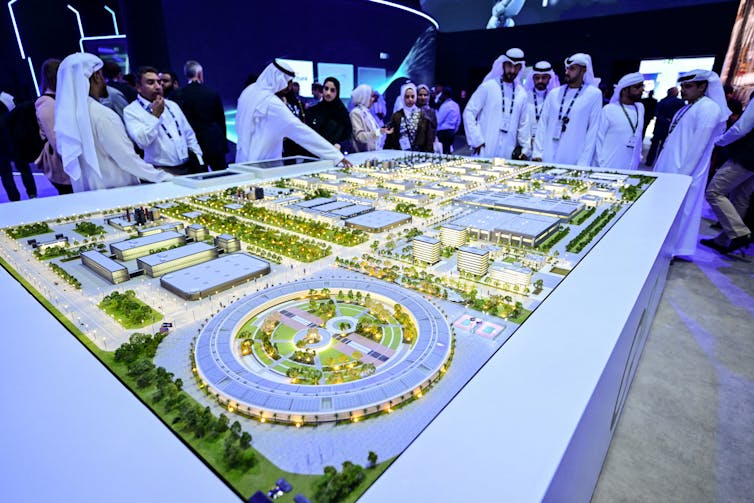
Giuseppe CACACE/AFP via Getty Images
Growing importance, easy targets
Although data centers are still very important for national security, the economy and society as a whole, it would be tempting to suggest that these sanctions represent a fundamental change in the nature of warfare. Although that is a possibility, it is important to remember that Iran produced thousands of missiles and drones that target the UAE. While the majority were caught, the two that affected data centers are a small fraction of those that targeted civilians in the UAE, including strikes at airports and hotels.
The relative vulnerability of commercial data centers – they are large, fragile and lack dedicated air defense – suggests that those in the UAE may be targets of opportunity or convenience. In other words, they were beaten because they could be beaten.
However, it seems that as the use of AI tools and other cloud-based tools continue to grow in importance for countries around the world, business data centers will be targets in future conflicts.
#Iran #targeting #Amazons #data #centers #changing #war