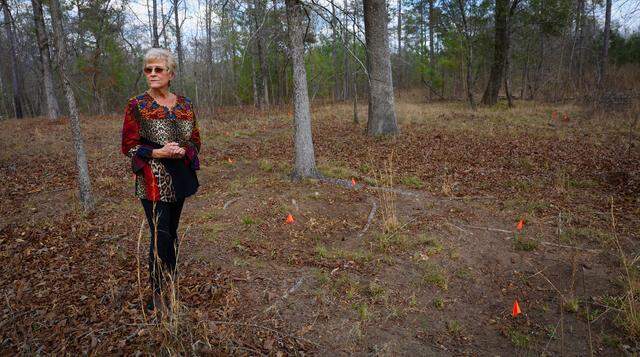
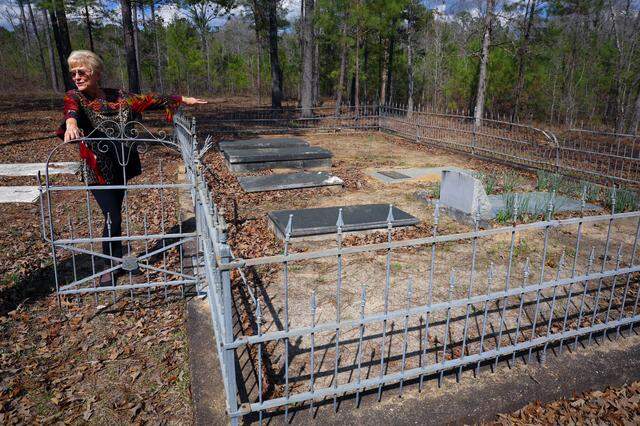
Less than two miles from the property line belonging to Habitat Real Estate Partners, who are working to bring a 650 megawatt hyperscale data center to Columbus, property owner Debbie Jackson has a family cemetery with 22 graves, including her husband, whom she buried in September.
[–>
Although 2025 was “very tough,” Jackson said, 2026 has thrown her “for a loop” since she learned the approximately 900 acres in northeast Muscogee County that was sold in November for $4.2 million is the site for the proposed $5.18 billion Project Ruby data center.
[–>
Jackson spent most of August last year going to doctor appointments to find out what was wrong with her 68-year-old husband, John. She went on intermittent unpaid family leave from her banking job at Truist, her last of several banking jobs for 41 years in the Columbus area. A month after being informed her husband needed a liver transplant, he died Sept. 10.
[–>
Over 400 people came to the service held at the family cemetery, a stone’s throw from Jackson’s house on Layfield Road, Jackson said.
[–>
The oldest grave is her husband’s great-grandfather from 1852. The cemetery also contains graves from three other families dating back to the 19th century: Lee, Jenkins and Cartledge..
[–>
Jackson said her husband told her shortly after she moved from Columbus to Upatoi in 1993 the cemetery was registered a historic site. However, she doesn’t have the paperwork, and the Historic Columbus Foundation doesn’t have such a record.
[–>
Even more unclear is what sort of measures ought to be taken with dozens of unmarked graves, a different direction from her house and the Civil War-era family cemetery.
[–>
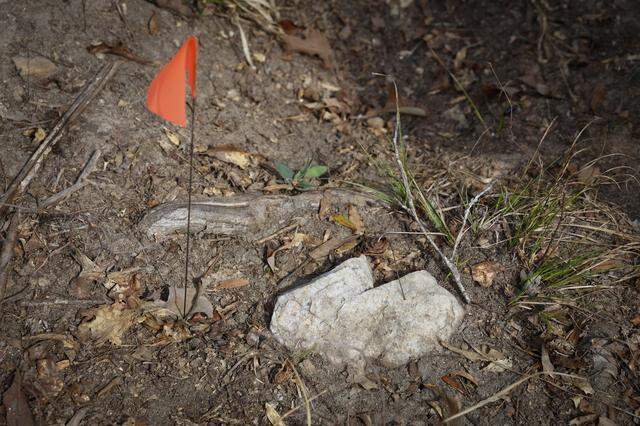
“I don’t know if these are slaves or Indians,” she said, as she showed the Ledger-Enquirer the concave graves she marked with orange flags.
[–>
[–>
Jackson said her husband showed her these graves when she first moved in with him 33 years ago. But they haven’t had an expert, such as an archaeologist or an official from the Muscogee Creek Nation, visit to determine who is buried in these graves.
[–>
Still, if zoning and permits for the proposed data center are approved, Jackson wonders whether her family’s cemetery and the unmarked graves can be protected. Plus, she is concerned about her safety.
[–>
“I’m really nervous about thermal runaway,” she said. “Do I have my passport and everything ready at a moment’s notice?”
[–>
Jackson learned this term from a woman who spoke during the first Columbus Planning Advisory Commission meeting to discuss Project Ruby on March 4.
[–>
Thermal runaway is when a fire can’t be extinguished because it’s a constant feedback loop of materials conducive to fire, like lithium batteries. The woman who spoke at the PAC meeting suggested anyone living within 10 miles of a data center is in danger of this occurrence.
[–>
In a 5-1 vote March 18, the PAC recommended to the Columbus Council a technology overlay district ordinance that changed the proposed buffer zone for Project Ruby from 75 feet to 500 feet.
[–>
“That is still not enough,” Jackson said.
[–>
[–>
Jackson is concerned about health issues associated with people who live within certain proximities to data centers.
[–>
“I don’t want my life expectancy dwindled, and I don’t want to be here if there is 24/7 daylight, noise from generators, and a removal of all these trees around us,” she said.
[–>
After retiring in December, and inheriting tractors and trailers and managing the land on her own, Jackson feels torn about whether to stay or sell.
[–>
“It’s all very up in the air,” she said.
[–>
There is an $800 mortgage on her 33-year-old home that won’t be paid off until 2044, Jackson said, but she is certain her property value would decrease if the data center is built.
[–>
Jackson doesn’t have a water bill, thanks to her home being on well water. But if the city forced her to get city water because of Project Ruby — which would bring city water to the area — she wants the data center to pay for the pipes that would go to her home.
[–>
“You hear about contamination (of water from data centers),” she said.
[–>
Jackson’s electric utility is EMC co-op Flint Energies. She pays about $150 per month. Her highest bill is around $300 for a month with extreme temperatures.
[–>
Her husband loved their property, Jackson said, not just because it has been in the family since the mid 1800s but also for the woods where he hunted turkey and deer.
[–>
“He would roll over in his grave if something happened to this land,” she said.
[–>
[–>
Jackson has the rights to 15.22 acres, where her house and all the graves and family cemetery are located, and her son and sister-in-law inherited the other 200 acres.
[–>
Since learning about the data center in February, Jackon’s son, Bradley, isn’t sure about whether to stay and build his own house on the property or leave because of the proposed data center.
[–>
“I’d love to see council out here; move your family, your grandchildren out here,” he said. “Are you going to agree with us or tell us a bunch more lies?”
This story was originally published March 30, 2026 at 5:02 AM.

Black Hunter
Columbus Ledger-Enquirer
Kala Hunter is a reporter covering climate change and environmental issues in Columbus and throughout the state of Georgia. He has a master’s of science in journalism from Northwestern’s Medill School of Journalism. He holds a bachelor’s degree in environmental studies from Fort Lewis College in Colorado. He has worked on green foundations in California and Nevada. His work appears in the Bulletin of Atomic Science, Chicago Health Magazine, and the Illinois Latino News Network.
#family #cemeteries #property #road #Columbus #data #center